Developing physics-informed machine learning models that bridge quantum mechanical accuracy with classical simulation efficiency.
Overview
My research in machine learning for materials science focuses on using computational methods that combine the physical accuracy of quantum mechanics with the efficiency and scalability of data-driven approaches. By developing physics-informed machine learning techniques, I aim to accelerate materials discovery and provide deeper insights into complex materials phenomena that are challenging to model with traditional methods.
Key Research Directions
Neural Network Interatomic Potentials
I develop machine learning models that can predict atomic interactions with quantum mechanical accuracy, focusing on:
- Training neural networks on quantum mechanical data to predict energies and forces
- Optimizing models for transferability across different chemical environments
These machine learning potentials enable simulations of large, complex systems with accuracy approaching quantum mechanical methods but at a fraction of the computational cost, opening new possibilities for materials modeling.
Structure Generation Tools (CHAOS)
I also develop tooling for large-scale structure generation through my open-source codebase:
- Building initial atomistic configurations for complex disordered systems
- Generating simulation-ready structures for ML potential training and production MD
- Supporting large-scale Na-HC system generation used in published work
Project repository: CHAOS on GitHub. A representative application is large-scale Na-HC structure generation used in the paper Physics-informed machine learning exploration of Na storage mechanisms in disordered carbon.
MLIP-Toolkit
I am developing MLIP-Toolkit, an agent-ready framework for end-to-end machine-learning interatomic potential (MLIP) development.
The toolkit is designed to streamline the full workflow from raw simulation data to validated, production-ready models.
It includes dataset preprocessing pipelines for structure and label consistency checks, cleaning, formatting, and split generation, along with automated routines for preparing training-ready inputs across MLIP backends.
On the back end, it provides post-training analysis and diagnostics to evaluate model fidelity, physical consistency, and domain reliability, helping ensure that deployed MLIPs are accurate on benchmarks and valid for intended simulation regimes.
By combining agentic workflows with physics-aware validation, MLIP-Toolkit reduces iteration time, improves reproducibility, and supports reliable MLIP deployment for large-scale atomistic simulations.
Co-developers: Jamie Holber, Josh Vita, and Kyle Bushick (LLNL).

AI/ML + Physics-Based Simulations for High-Throughput Electrolyte Screening
I integrate AI/ML models with physics-based simulations to accelerate high-throughput screening of battery electrolytes.
This workflow combines data-driven prediction with physically grounded validation to rapidly identify promising electrolyte candidates while preserving mechanistic insight and chemical reliability.
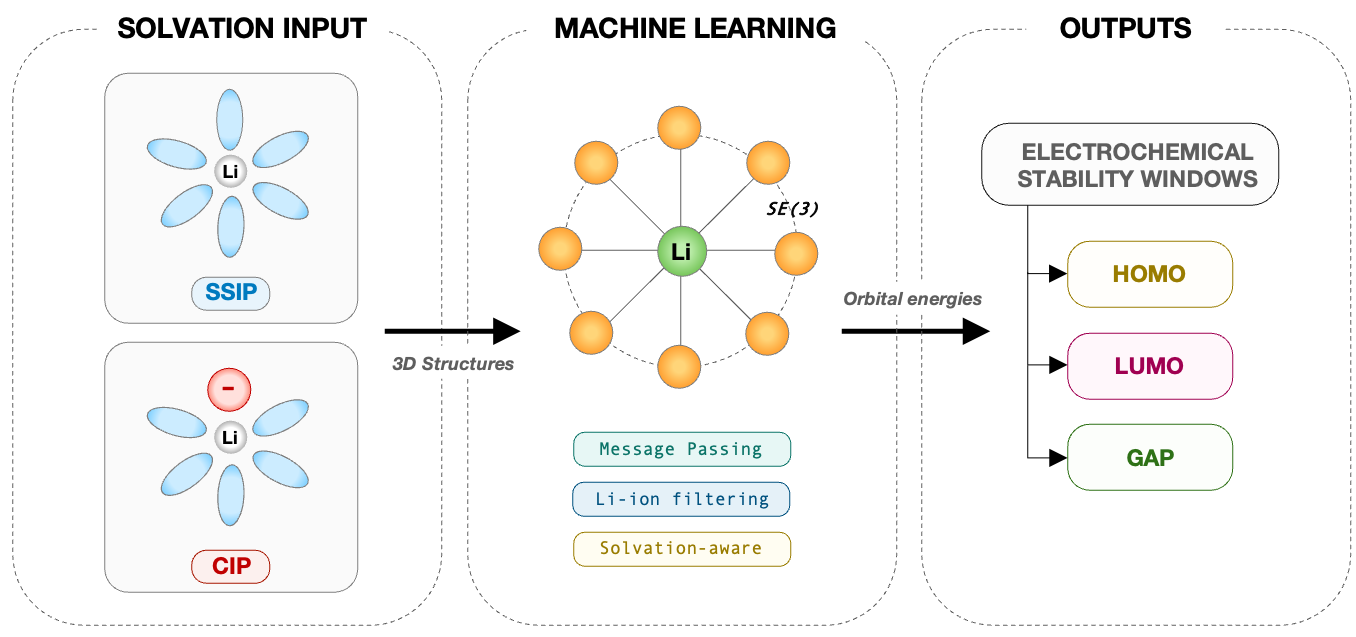
AI/ML + physics-based simulation workflow for high-throughput battery electrolyte screening, used to prioritize candidates for detailed validation.
Related paper: Integrated Machine Learning-Molecular Dynamics Framework for Electrolyte Property Prediction.
Integrated machine learning-molecular dynamics framework for electrolyte property prediction.
On the lookout: I am currently building an Electrolyte Discovery Platform for Na-ion batteries that integrates agentic workflows with large language models (LLMs) to accelerate candidate generation, simulation planning, and down-selection.
Interpretable AI for Materials Discovery
I work on making machine learning models more interpretable and physically meaningful:
- Using feature extraction techniques to identify key descriptors of material properties
- Example: physics-informed machine learning analysis of sodium storage mechanisms in disordered carbon
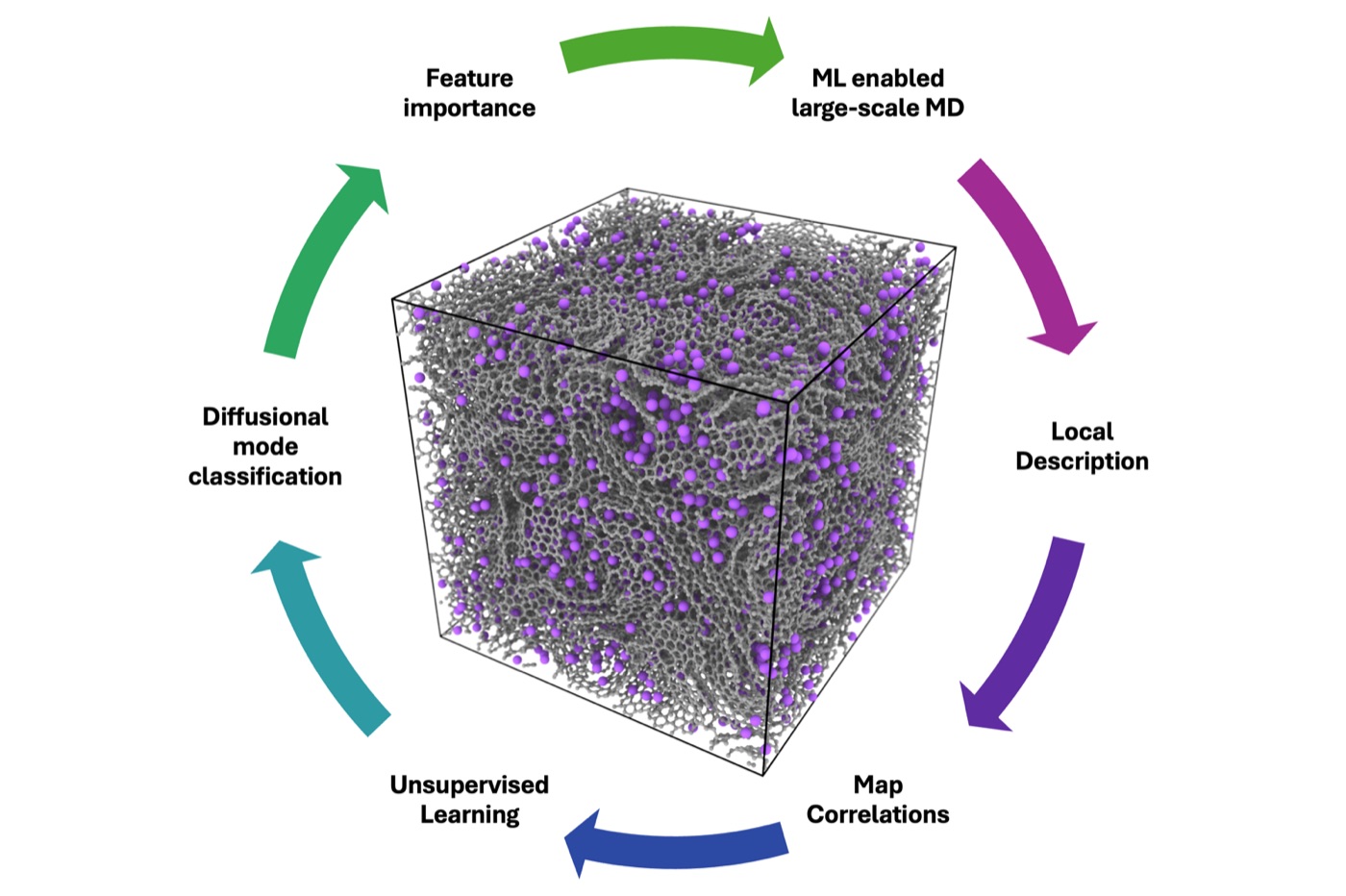
Interpretable machine-learning analysis linking model predictions to key physical descriptors, demonstrated on sodium storage mechanisms in disordered carbon.
By making machine learning more interpretable, my research aims to not only predict material properties but also generate new physical insights and guide the development of improved theoretical models.
Methodology
My machine learning research employs a range of advanced techniques:
- Graph-Based Neural Networks
Including graph neural networks and equivariant architectures for representing atomic structures - Physics-Informed Machine Learning
Incorporating physical principles as constraints or regularization terms - High-Throughput AI/ML Screening
Combining surrogate models with simulation pipelines to prioritize electrolyte candidates efficiently - Agentic LLM Workflows
Using LLM-guided planning and automation to accelerate electrolyte discovery for Na-ion batteries - Explainable AI Methods
Techniques for interpreting what neural networks learn about physical systems
Impact
My research in machine learning for materials science bridges the gap between quantum mechanical accuracy and classical simulation efficiency, enabling new approaches to materials discovery and design. This work has applications across multiple domains, including energy storage, catalysis, electronic materials, and structural materials. By accelerating the materials discovery cycle and providing deeper insights into materials behavior, my research contributes to addressing urgent technological challenges in energy, environment, and sustainable manufacturing.
Related Publications
Select publications related to machine learning in materials science:
Integrated Machine Learning-Molecular Dynamics Framework for Electrolyte Property Prediction
EES Batteries, 2026
View PaperPhysics-informed machine learning exploration of Na storage mechanisms in disordered carbon
Energy Storage Materials, 104967, 2026
View PaperElucidating Lithium Transport Mechanisms in Disordered LiF from Machine-Learning Molecular Dynamics Simulations
ACS Materials Letters, 2026
View Paper